
Infinite Pitch
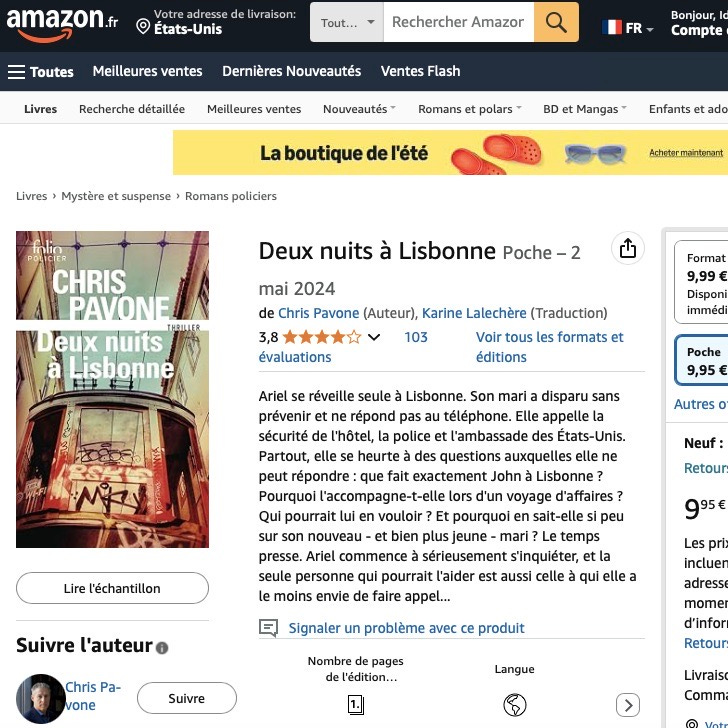
Or: how your query letter ends up on amazon.fr, in French.
I’ve written here about the one-pager as an essential tool for me, at the beginning of the process, to invent a novel. That’s just the beginning, and that’s just me. But there’s more to it, for every author. Much more. Every book makes its journey through the publishing process on the strength—or weakness—of a succession of one-pagers.
Here’s what’s going to happen:
The Agent Queries
Once you’ve written something you think can get published, you’re going to try to find a literary agent, by sending them query letters. Based on those queries—and likely nothing else—these people are going to ask to see a sample, or a full manuscript, or not. You’re going to send letters to 5, 10, 50, 100 agents before someone says yes please, happy to take a look.
If one of these agents eventually agrees to represent you, you’ll work on the manuscript together until both of you agree that the thing is ready to go out on submission. Your agent will then query a dozen editors via letter, or phone call, or a conversation over lunch, or drinks. “I have something I think you’ll love,” he’ll say, and give a quick pitch, and maybe an explanation of what’s great about this project.
If one of those editors reads it, and loves it, she’ll share the ms. with a few colleagues—a couple of peers, an underling or two, plus maybe people in sales, marketing, publicity. At an editorial meeting, she’ll spend a couple of minutes describing the book and why she loves it, opening up a conversation about the project’s merits and shortcomings, about the author, about this book’s place in the world, its comparison titles, its prospects for success. At some houses, the next stage is an acquisitions meeting, which is another chance for advocates and detractors to have their say.
If the project survives this gauntlet, the editor will put together a profit-and-loss statement (the P&L is a big subject, for another time) and present it to whichever officer of the company can grant formal permission to make an offer. This editor-in-chief or publisher or president or some other suit will look over the numbers—the advance, the expense assumptions, the comps, the sales projections—and listen to the editor’s pitch. Which, again, will be a minute or two. A page.
If this editor receives the thumbs-up, and makes you an offer, and you accept it—CONGRATULATIONS! You have a book deal.
At this point you might think your query letter has served its purpose, and can retire to a lazy life of basking in its glory on the beach.
Not even close.
The Publishing Documents
Over the course of the next year or two, a few people at the publishing house will create documents and presentations that will define the book while it makes its way through the house’s pipeline, and ultimately out into the world:
LAUNCH is an hours-long meeting at which the editorial department presents an entire season’s list of books to representatives of the rest of the publishing house—marketing and publicity and sales and maybe design and audio and production and finance and more, dozens or scores of people listening to descriptions of 20, 30, 40 books in one sitting (it can get tedious). The custom is for each book to be presented by its editor, and most editors read aloud descriptions that they’ve written; most of those descriptions are in the neighborhood of one page. Launch will be followed months later by other similar meetings—pre-sales conference, sales conference, marketing, each a discussion of the whole list title by title, the goals for each , how to achieve them. Most people at these meetings will have read the same thing for most of the books: one page.
BLURB QUERIES. You’ll want (euphemism for desperately need) endorsements from other writers, and your editor and agent are going to help procure them, and they’re going to begin by querying these other writers, via letters that look a hell of a lot like previous query letters: one-page pitches that focus on what’s great about this book.
ARC COPY is the description that fits on the back of an advance readers copy, or maybe inserted in the form of a one-page letter in front of the bound galley. ARCs and bound galleys (plus the more raw, less formatted version called a bound manuscript) are the prepublication editions that are sent out into the publishing universe to start building word of mouth among booksellers, media, blurbists.
T.I. SHEET or tip sheet, or fact sheet, or some other sheet (nomenclature varies) is a more complicated one-pager that includes the facts that everyone in-house needs to know—the on-sale date, the retail price, the trim size, the page count, maybe the carton quantity (!), etc.—as well as a description of the book that’s brief enough to fit on this one page.
CATALOG PAGE. The T.I. sheet will evolve into one page for the seasonal catalog (if your publisher still makes these) to present their wares to booksellers, to wholesalers, to agents, to other publishers, to other authors, to foreign agents—to the whole world. Again, one page.
THE PUBLICITY RELEASE, created by your publicist, will try to frame the book in a way that makes it look as if there’s a story about this book that someone—a reviewer, a journalist, a TV producer—might want to tell. This release is going to include blurbs, a full author bio, and a brief description of the book that, like all the others, is about a page long.
And, finally (but not really finally), is the FLAP COPY. You know what this is: the 200-300-word description on the hardcover’s front flap, whose goal is to convince readers that this book is a world they want to spend $30 and 10-plus hours of their life to inhabit.
Now you’ve published a book! Maybe the pitching has ended?
Ha.
The External Pitches
All of the above pitches are within the domestic publishing ecosystem. But wait, there’s more:
FOREIGN RIGHTS: Your literary agency’s foreign-rights specialist will put the project into the hands of foreign co-agents, who start this process from Square 2 all over the globe, to try to make deals for translation rights in each of possibly dozens of markets, where hopefully almost all the above will happen again, generating one-page pitches for catalog pages and cover copy in Swedish and German, Turkish and Hebrew, Japanese and Simplified Chinese.
HOLLYWOOD: Your agent (either your lit agent or a book-to-film specialist) will shop the thing for feature or series. All these people will of course read the one-page pitch first, then at the far end of reading (or skimming) your ms. they will produce their own one-pager with a recommendation. If you’re lucky enough to procure a deal, the option holder will go out into their world to try to put together all the other parts, and all the other players, and all the other money that’s needed to get something made. And each and every one of these solicitations will start with what? You know the answer.
RETAILERS: The flap copy gets fed out to Amazon, to bookshop.org, to B&N, to Target.com . . . Every online retailer is going to regurgitate the flap copy as the store’s product description. And not just in the U.S., but in every territory where the book is published, all over the planet.
And this is how it comes to pass that a page you wrote to help conceptualize a novel—a novel you’d yet to begin—can end up, years later, adapted into the coverage that lands on the desk of Steven Spielberg, or coming out of the mouth of a radio interviewer, or translated into French on amazon.fr.
Your Pitches
If every break goes your way, two or three or ten years after you wrote that first book description, you will attend a conference, where you will sit on a raised dais, participating in a panel with a handful of other authors. The moderator will turn to you, and say, “Tell us about your book.”
Your neighbor will slide the microphone across the table. You will take a deep breath.
The hope—the dream—is that you’ve gotten the opportunity to repeat your pitch dozens of times, in bookstores and libraries, at festivals and conferences, on podcasts and radio shows and nationally televised morning shows, over and over and over again, for years. My first novel was published in early 2012; I started describing it in 2010. Fifteen years later, I still find myself talking about that book, and I hope to still be doing it 15 years from now. This is, actually, the goal: to never stop talking about a book.
The Shape of It
There will be dozens of individual pitches, presented by nearly as many people, for a wide variety of audiences, in many forms: written pitches aimed at an audience of one, or a dozen, or hundreds; verbal pitches in small meetings and big, formal and informal, on the phone and on zoom and in person; pitches that are circulated within the publishing house, and out to other authors, to booksellers, to media; pitches that are distributed to the vast public, printed on the glossy stock of a hardcover’s dust jacket. And almost every single one will have the same shape:
Title.
Author.
One-sentence reading line.
A description of 200 to 300 words, fitting on 1 page, or a couple minutes of speaking, that makes an argument for why this book is special.
And here’s something crucial to understand: almost every one of those pitches will be a revision of the prior one. Your agent will rephrase your query letter into his own submission letter. Your editor’s assistant will repurpose the agent’s submission letter into the T.I. sheet and the blurb-solicitation notes. Someone will revise those into the catalog copy, which will evolve into the publicity release, as well as the flap copy, which will be fed out as the retailer descriptions.
Again and again, everyone who needs to write a pitch will first read the previous one. If it’s not broken, no one needs to fix it. Just copy-paste, replace a few vocabulary choices, tweak the headline, boom, done.
This is just as true for your book as it is for mine as it is for Stephen King’s. Whether the author is a complete unknown or an established mega-bestseller, every book makes it ways through the system the same exact way: it lives on the strength of its one-page description, and possibly dies on its weakness.
Here’s a tough pill to swallow: Many of the people who are involved in your book’s publication are not going to read it. They’re going to learn everything they need to know from a one-pager. This is true among the publishing-house personnel, and in the external publicity outlets, and the bookselling community, and beyond. Almost all of the people who say no thanks, not interested, will have read only one page.
Is this unfair? Fair and unfair have nothing to do with it. This is how it works. You can choose to resent it, but you can’t change it. The only part that’s in your control is this: you can start the whole long journey by building that first solid raft yourself.
You will probably not be invited to—nor welcome to—write the ARC copy or flap copy, much less the foreign-rights submissions, the publicity release, the film-industry coverage. You won’t even see almost any of this. But if you do your job well, you’ll have written it anyway, and Spielberg will never have any idea whatsoever that it came, at heart, from you.
If you already have an agent, and a contract with a publishing house, you can skip the first one or two of the above iterations. But just because you can, should you? Maybe you should build it anyway, the strongest possible one-page raft. After all, this is what’s going to keep you afloat through a long treacherous journey. Don’t you want to make sure this thing is watertight before you set off?
I sure do.
WFH
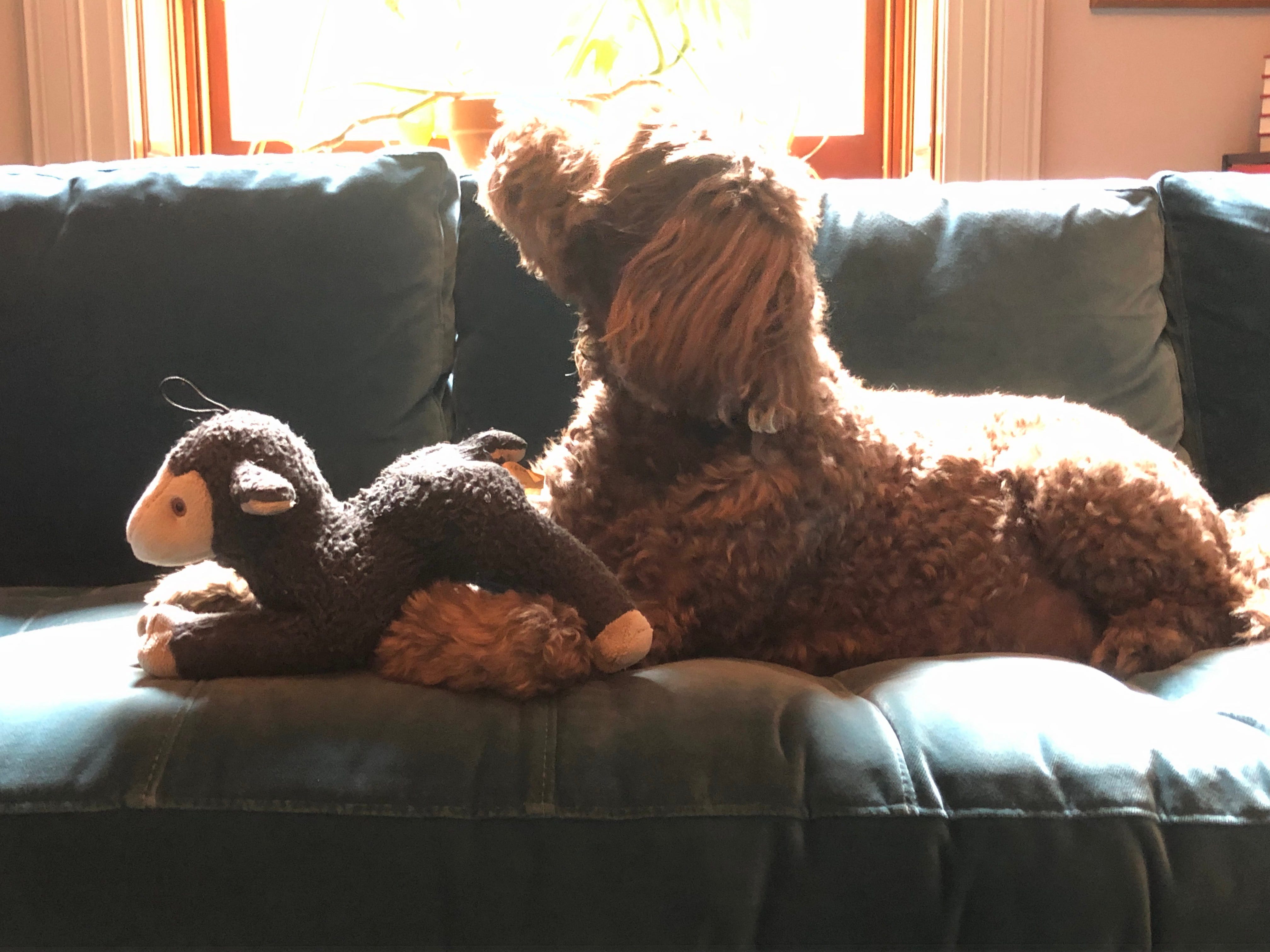
Five-plus years after the onset of covid, I think we all recognize our own benefits and distractions of working at home. Here’s one of both, on the opposite couch from me, as I type this:
Love this. An insider’s look at the arduous process of being creative. Knowing all of this, I still am all in. It’s no surprise that you can write great fiction as well as straightforward nonfiction about writing!
By the way, this post of yours and the new book by @Kate McKean Write Through It should hang out sometime. They would be good friends! In fact, you guys probably know each other!
So helpful! I've sent to a bunch of writers who are working on their queries and one-pagers right now!